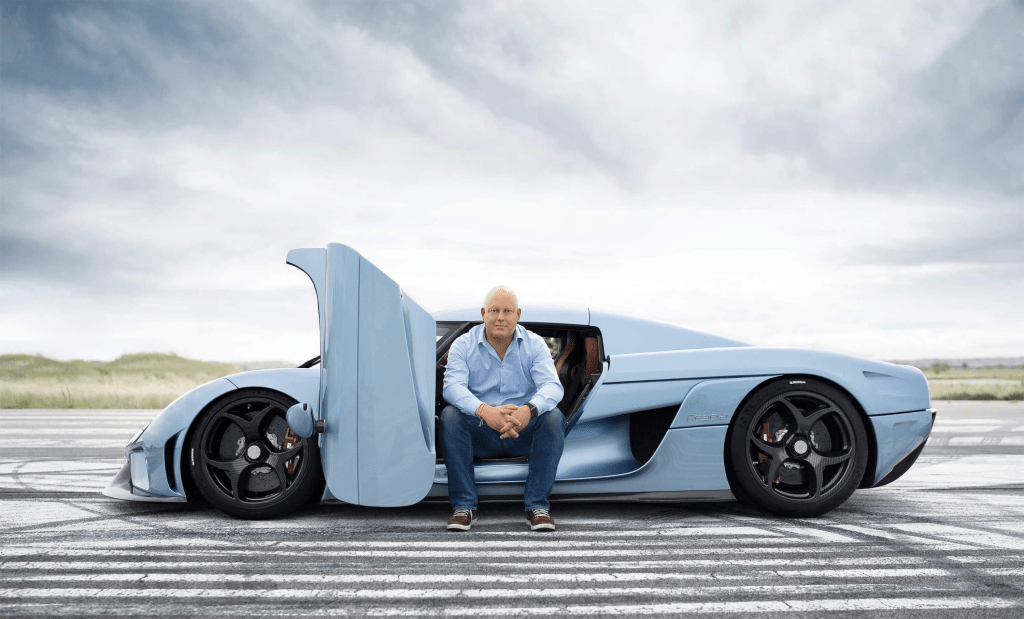
In the realm of high-performance automobiles, few names evoke as much awe and admiration as Koenigsegg. At the heart of this Swedish marque is Christian von Koenigsegg, a man whose relentless pursuit of perfection has redefined the supercar industry. From a young boy inspired by a Norwegian animated film to the founder of a world-renowned automotive company, Christian’s journey is a testament to innovation, resilience, and an unyielding passion for speed.
A Dream Ignited
Christian von Koenigsegg’s fascination with cars began at the tender age of five after watching the Norwegian animated film “Flåklypa Grand Prix.” The movie tells the tale of a humble bicycle repairman who builds a race car to compete against the world’s best. This story ignited a spark in young Christian, planting the seed of a dream to create the perfect sports car. As he grew, so did his passion, leading him to delve deep into the mechanics and engineering of automobiles.
Laying the Foundation
Before venturing into the automotive world, Christian showcased his entrepreneurial spirit by founding a trading company at 19, dealing in goods like frozen chicken. While successful, this venture didn’t align with his true passion. By 1994, at the age of 22, he decided to pursue his dream wholeheartedly, establishing Koenigsegg Automotive with the vision of creating the world’s greatest sports car. This bold move marked the beginning of a journey filled with challenges, innovations, and groundbreaking achievements.
The Birth of a Supercar
The initial years were anything but smooth. Christian and his small team embarked on designing a prototype that would embody their vision of automotive perfection. After two years of relentless effort, the Koenigsegg CC prototype was unveiled in 1996 at the Anderstorp race track, marking the company’s first public appearance. This debut garnered significant attention, setting the stage for future developments. However, the path to production was fraught with obstacles, including a devastating fire in 2003 that destroyed their facility just weeks before the Geneva Motor Show. Undeterred, the team salvaged what they could and pressed on, showcasing their resilience and commitment.
Pushing Boundaries
Koenigsegg’s journey is marked by a series of innovations that have consistently pushed the boundaries of automotive engineering:
- CC8S (2002): The company’s first production car, which earned a Guinness World Record for the most powerful production engine at the time.
- CCR (2004): An evolution of the CC8S, the CCR set a new top speed record in 2005, reaching 387.86 km/h at Italy’s Nardò Ring.
- CCXR (2007): Introduced as the world’s first “green” supercar, capable of running on E85 ethanol, producing an astounding 1,018 horsepower.
- One:1 (2014): Dubbed the world’s first “megacar,” it achieved a 1:1 power-to-weight ratio, delivering 1,360 horsepower and weighing 1,360 kg.
These milestones underscore Christian’s commitment to innovation, sustainability, and performance.
Innovations Beyond Speed
Christian von Koenigsegg’s brilliance isn’t confined to producing fast cars; it’s evident in the groundbreaking technologies his company has pioneered:
- Freevalve Technology: A revolutionary camless engine design that offers infinitely variable valve timing, improving performance and fuel efficiency.
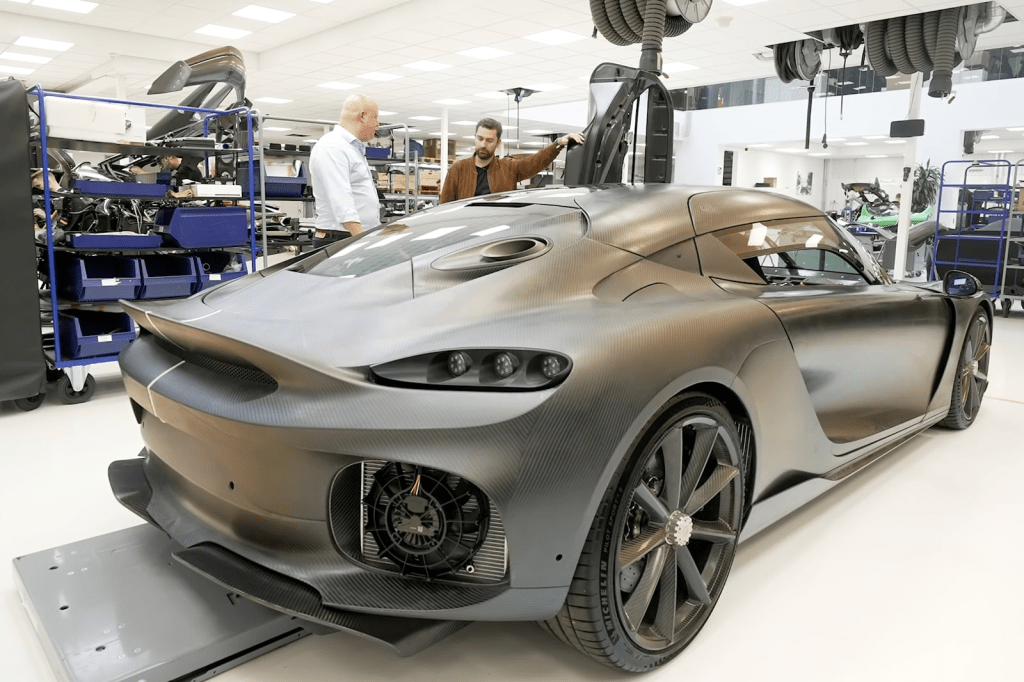
- Advanced Carbon Fiber Techniques: Koenigsegg has developed unique methods of using carbon fiber, making their cars lighter, stronger, and safer.
- Proprietary Engine Designs: Instead of relying on external suppliers, Koenigsegg designs and builds their own engines, ensuring they meet the company’s exacting standards.
These innovations highlight the company’s holistic approach to automotive excellence, focusing on every detail to enhance the driving experience.
Trials and Triumphs
The journey to success was not without its trials. The 2003 fire was a significant setback, destroying many of the company’s early records and facilities. However, this adversity only strengthened Christian’s resolve. The team relocated to a former Swedish Air Force base in Ängelholm, a move that not only provided ample space for expansion but also imbued the brand with a unique heritage. The “ghost” symbol adorning Koenigsegg cars pays homage to the “Ghost Squadron” that once operated from the same base, symbolizing the company’s resilience and pioneering spirit.
Legacy of a Visionary
Today, Koenigsegg stands as a beacon of innovation in the automotive world. Christian von Koenigsegg’s unwavering dedication has transformed a childhood dream into a reality that continually redefines what’s possible in automotive engineering. His story serves as an inspiration, demonstrating that with passion, innovation, and resilience, even the most ambitious dreams can be realized.


Leave a comment